2B1ASK1 Square & Compass Masonic Lapel Pin - [Blue & White][3/4'' Tall]
At three-quarters of an inch, it sits on a lapel without announcing itself across the room — sized for daily wear rather than a formal Lodge night.
Details
Shop by category
Shop by body
Read
Square and compasses, past master, Templar, eagle, fez, star.
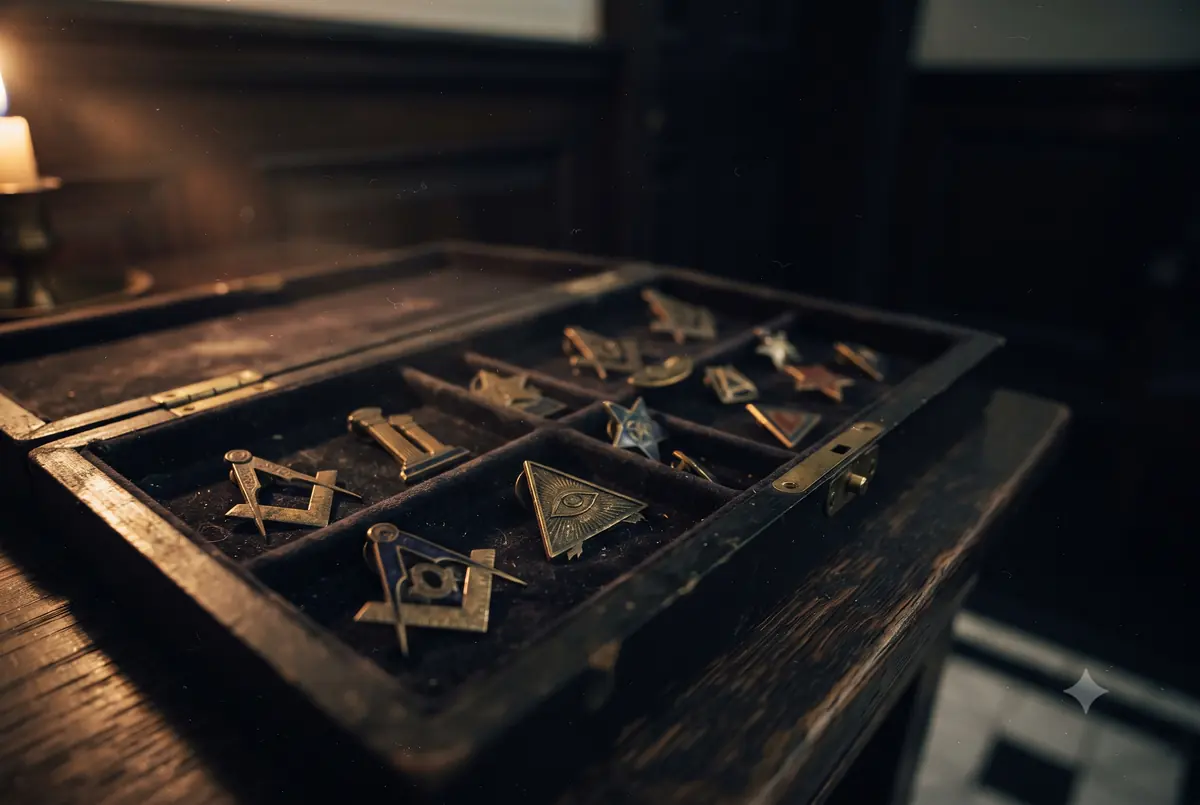
The quietest way to wear the Craft, and the cheapest entry point in the whole catalog. A lapel pin says it to the people who already know and stays invisible to everyone else, which is most of the appeal.
The everyday pin. Plain, round, enamelled and rhinestone.
At three-quarters of an inch, it sits on a lapel without announcing itself across the room — sized for daily wear rather than a formal Lodge night.
Reads 'Ancient Free & Accepted Masons' — check whether that matches your Grand Lodge's formal name before buying as a lodge gift, since the A.F.&A.M. and F.&A.M. distinction matters in some jurisdictions.
This pin marks the second degree specifically, not the lodge at large. If you want something to wear as a raised Master Mason, the Master Mason version is what you want.
A small, quiet identifier rather than a statement piece. Low review count makes the quality ceiling a little uncertain, but the rating holds.
An everyday-wear pin, not a regalia piece. It goes on the lapel at a casual meeting or a public event, not in the lodge room during degree work.
Prince Hall and mainstream Grand Lodges are distinct jurisdictions with separate identities. This pin is specific to Prince Hall Masons and is not interchangeable with a generic square-and-compass pin.
The square and compass is a Blue Lodge emblem, so the Shrine categorization is incidental. Suitable for any Master Mason regardless of appendant-body membership.
The emblem with the flag, for veterans, police, and Lodge flag nights.
At one inch, this reads clearly on a lapel without looking crowded next to a name badge. The Masonic Exchange is a dedicated supplier, which generally means the emblem proportions are right.
The flag-and-emblem combination reads clearly at a glance on a hat brim or a lapel — which is the whole job of a pin.
Pairs the square and compasses with a patriotic phrase. Simple buy for a member who wants to wear both affiliations at once; nothing jurisdiction-specific about it.
Pairs the national flag with the square and compass in a single set — useful if you want both without hunting for two separate listings.
For the Mason who is also in law enforcement. The combined iconography is specific enough that it reads oddly on anyone outside that overlap.
The patriotic framing makes this practical beyond Lodge — a single pin that reads as both civic and Masonic on a suit lapel at a public or veterans' event. Any Master Mason can wear the Square & Compass.
Combines the flag and the square-and-compass into one pin — the straightforward choice for Brothers who are also veterans and would rather wear one piece than two.
The flag-and-compass combination signals two identities at once. Specific to Brethren who served; it does not read as a general lodge pin.
Trowel, acacia, the 47th problem, the mosaic pavement and more.
The acacia is a Blue Lodge symbol with no rank attached, so any raised Mason can wear it. One inch sits at the larger end for a lapel pin and reads better on a suit coat than a shirt collar.
Three matching pins at about 3/4 inch each, built around the 47th Problem of Euclid. The geometry carries meaning from the Master Mason degree onward, and the set format makes more sense than buying one at a time.
The 47th Proposition is the more cryptic end of the Masonic pin catalog. The grid makes the underlying theorem legible on the face of the pin, which most renderings of this symbol leave off.
The altar motif has particular resonance in York Rite ritual, which makes this a more considered choice than a generic Square and Compasses pin. At one inch in antique brass, it sits cleanly on a lapel.
The mosaic pavement is a universal Blue Lodge symbol, so this pin works in any jurisdiction. At 5/8", it sits on the lapel without announcing itself.
The point-within-a-circle is one of the oldest emblems in the tradition. Most Brethren will recognize it immediately, so it reads as a considered choice rather than generic Masonic decoration.
The trowel is a working tool of the Master Mason degree, so any raised Brother can wear this, not just York Rite Masons. The pin pairs it with the square and compass, making the third-degree symbolism explicit.
The trowel is the working tool of the Master Mason degree, so the added symbol carries specific meaning and distinguishes this from a plain Square & Compass pin. One for the raised Mason, not a candidate gift.
For new-member kits, table lodges and outreach, not for wearing to Lodge.
Priced and packaged for giving away, not wearing to Lodge. Useful for table lodges, civic tabling, or new member kits where unit cost matters more than finish quality.
Three-pack of rhinestone-accented Square and Compass pins — flashier than plain enamel, useful if you want spares or one for each jacket. If you prefer the traditional look, the plain gold-on-blue version is quieter.
Three matching pins at about 3/4 inch each, built around the 47th Problem of Euclid. The geometry carries meaning from the Master Mason degree onward, and the set format makes more sense than buying one at a time.
Three pins in one pack. Useful for keeping a spare when one goes missing, or for giving one away without breaking up the set.
A practical bundle if you want coordinated Masonic accessories for lapel, tie, and cuffs in a single order. The trowel reads clearly to those who know it and stays understated to those who do not.
For Past Masters and those holding or having held the office shown.
For Past Masters only. The emblem marks an office that has been conferred, not an aspiration.
A full officer-line set intended for a Lodge to hand out at installation, not a personal buy. A brother wears only the pin for the office he currently holds.
This carries the Past Grand Master emblem, which is restricted to those who have served as Grand Master of a Grand Lodge — not a Past Master of a subordinate lodge. Buy accordingly.
The Past Master emblem is an earned distinction — this is for Brothers who have been installed in the East, not for general Masonic wear.
Reserved for those who have served in the East. If you haven't occupied the chair, this one isn't yours to wear.
The Past Master emblem belongs only to those who have served as Worshipful Master of a lodge. A reasonable gift if you know the recipient qualifies, but verify they do not already own one.
Royal Arch, Red Cross of Constantine and Commandery, for their members.
A presentation piece sized for a Knights Templar Commandery member, not a lapel pin. The coin face carries the full Templar motto in Latin, which gives it some weight as a formal gift.
This is for members who have received the Templar Orders in the York Rite. Not appropriate before that point.
For York Rite Masons who have received the Order of the Temple through a Commandery. Not a general Masonic emblem.
The red cross on white shield is a Templar device — this is for Knights Templar members in the York Rite, not for Blue Lodge.
For members of the Order of the Temple only. The Templar cross is not a general Masonic emblem and should not be worn before completing the Commandery degrees.
A Commandery pin for a Knight Templar. The 4.9 rating rests on fifteen reviews, which is a thin sample; treat it as promising rather than proven.
York Rite Knights Templar pin; the Armor of God theme is specific to the Order. Not appropriate before receiving the Orders of Knighthood.
14°, 32° and 33° emblems, for Scottish Rite members holding the degree.
For Scottish Rite members who have received the 14th degree. Not appropriate to wear before that conferral.
For 32° Scottish Rite Masons only — the double-headed eagle is that degree's emblem, not a general Masonic symbol.
For 32° Scottish Rite members — the Rose Croix cross is not a Blue Lodge emblem and should not be worn before reaching that degree.
For 32° Scottish Rite members; the combined Square & Compass with 32° mark makes the degree affiliation explicit. The 120+ reviews give this a more reliable read than similar pins with fewer buyers behind them.
Fez, scimitar and crescent, and camel pins, for Nobles.
Each emblem on this pin represents a separate body with its own membership requirements. Only appropriate for someone who has been raised as a Master Mason, has received the 32° in the Scottish Rite, and has joined the Shrine. Buy as a gift only if you are certain the recipient qualifies for all three.
For Nobles only. The fez is a Shrine emblem and is not appropriate for anyone who has not been received into a Shrine Temple.
The camel is the emblem of the AEAONMS, the Prince Hall-affiliated Shrine. This is a different organization from the mainstream AAONMS; confirm which body you belong to before ordering.
The fez is the Shrine's emblem; this pin is for Nobles of the Mystic Shrine. Not Blue Lodge insignia.
For Nobles only. At half an inch it is among the smaller Shrine pin options, which suits those who prefer something less conspicuous than a full fez emblem.
The Silent Messenger is a Shrine-specific device — for Shriners, not Blue Lodge or other appendant bodies.
The five-pointed star and the star-point pins, for members of the Order.
The pin represents the Adah point specifically, so it carries more meaning for an OES member than as generic Eastern Star jewellery.
The Martha point specifically, not a generic OES star pin. Worth checking whether the recipient holds that particular office before buying.
For Order of the Eastern Star members. The listing name covers both a hat and a lapel pin — confirm which variant you are ordering before purchase; the product images will clarify.
For OES members. A 5.0 from 48 buyers is encouraging but thin data; useful as an understated everyday pin for those who want something smaller than the full star.
The OES five-pointed star points down by design, which occasionally surprises people seeing it for the first time — worth mentioning if this is a gift for a non-member. No construction specs in the listing, but 120 reviews at 4.7 is a workable signal.
For members recognizing 25 years in the Order of the Eastern Star. A service pin rather than a decorative one: the milestone is the point, not the metal.
A standard OES lapel pin with a solid 58-review base. The 1-inch height is on the larger side for a lapel pin, which makes it visible across a room.
The crystal setting makes this more decorative jewelry than formal regalia, so it fits casual OES events better than degree work. Twenty-five reviews is a thin base; quality confidence is moderate.
Buying guide
A lapel pin is the smallest commitment in the catalog and the easiest gift to get right: no sizing, and nobody minds owning two. Most Masons wear one on the left lapel, but that is habit rather than rule.
A pin carrying the Past Master jewel, an officer’s jewel, the Templar cross, the double-headed eagle, the 33°, the Shrine emblem or the Eastern Star says the wearer holds that office or membership. Buy those only for the person who does.
Service-year pins (25, 50 years) are in many jurisdictions presented by the Lodge or Grand Lodge, so check before buying one as a gift; it may already be on its way.
The size, stated in inches: three-quarters of an inch reads as discreet, an inch and a quarter as a statement. The back: a clutch back is the norm, and a pin that spins on its post gets lost. And the finish, since “gold tone” describes the colour, not the metal.
Usually the left, over the heart, but there is no rule that holds everywhere. Follow what the Brethren in your Lodge do.
You can buy one as a gift for a Noble. Wearing it yourself signals Shrine membership, which requires being a Master Mason and joining a Shrine. See the Shrine explained.
“To be one, ask one.” Freemasonry has traditionally not solicited members, so a man who wants to join is expected to ask a Mason. The pin is an open invitation to do that. See how to join a Lodge.
Customs differ between Grand Lodges and between the appendant bodies. Your Lodge Secretary is the authority for your jurisdiction. We do not sell or ship anything: catalog links go to Amazon, where current details live.
At one inch, this reads clearly on a lapel without looking crowded next to a name badge. The Masonic Exchange is a dedicated supplier, which generally means the emblem proportions are right.
Priced and packaged for giving away, not wearing to Lodge. Useful for table lodges, civic tabling, or new member kits where unit cost matters more than finish quality.
For Scottish Rite members who have received the 14th degree. Not appropriate to wear before that conferral.
Made for the 25-year milestone specifically, so useful as a presentation gift or lodge award rather than everyday wear. The rhinestone setting makes it read more formal than a plain enamel pin.
At three-quarters of an inch, it sits on a lapel without announcing itself across the room — sized for daily wear rather than a formal Lodge night.
For Knights Templar commandery members who run gear that takes hook-and-loop patches. The polyester construction holds up to outdoor use better than embroidered cloth patches, though the khaki colorway may not suit all kit.
Each emblem on this pin represents a separate body with its own membership requirements. Only appropriate for someone who has been raised as a Master Mason, has received the 32° in the Scottish Rite, and has joined the Shrine. Buy as a gift only if you are certain the recipient qualifies for all three.
For 32° Scottish Rite Masons only — the double-headed eagle is that degree's emblem, not a general Masonic symbol.
For 32° Scottish Rite members — the Rose Croix cross is not a Blue Lodge emblem and should not be worn before reaching that degree.
Three-pack of rhinestone-accented Square and Compass pins — flashier than plain enamel, useful if you want spares or one for each jacket. If you prefer the traditional look, the plain gold-on-blue version is quieter.
For Nobles only. The fez is a Shrine emblem and is not appropriate for anyone who has not been received into a Shrine Temple.
The camel is the emblem of the AEAONMS, the Prince Hall-affiliated Shrine. This is a different organization from the mainstream AAONMS; confirm which body you belong to before ordering.
The acacia is a Blue Lodge symbol with no rank attached, so any raised Mason can wear it. One inch sits at the larger end for a lapel pin and reads better on a suit coat than a shirt collar.
The pin represents the Adah point specifically, so it carries more meaning for an OES member than as generic Eastern Star jewellery.
Reads 'Ancient Free & Accepted Masons' — check whether that matches your Grand Lodge's formal name before buying as a lodge gift, since the A.F.&A.M. and F.&A.M. distinction matters in some jurisdictions.
The flag-and-emblem combination reads clearly at a glance on a hat brim or a lapel — which is the whole job of a pin.
A presentation piece sized for a Knights Templar Commandery member, not a lapel pin. The coin face carries the full Templar motto in Latin, which gives it some weight as a formal gift.
This is for members who have received the Templar Orders in the York Rite. Not appropriate before that point.
Pairs the square and compasses with a patriotic phrase. Simple buy for a member who wants to wear both affiliations at once; nothing jurisdiction-specific about it.
Specifically for the First Degree. If you have been raised to Master Mason, the EA designation is not the right identifier for your lapel.
Read First
Know what you are buying before you buy it.
No symbols decoded, no conspiracies confirmed. What the fraternity actually is, where it came from, what happens at a meeting, and what it is not.
Read the guideTwo appendant bodies, constantly confused. The real differences in structure, degrees, theme, cost, and regalia, and why neither one outranks a Master Mason.
Read the guideThree bodies, one route. What the Royal Arch, the Cryptic Council, and the Knights Templar Commandery each are, what they cost, what regalia you need, and where to stop.
Read the guide