Scottish Rite Rings: 14°, 32° and 33° Explained Before You Buy
Who may wear a Scottish Rite ring, what the 14° and 32° designs show, why a 33° ring cannot be bought on request, and what to check on a listing before ordering one.
A Scottish Rite ring is not a general Masonic ring. It says the wearer belongs to a particular body and has received a particular degree, which makes it a poor guess as a gift and a good purchase for the man it actually fits. This guide covers who that is, what the designs mean, and what to read on a listing before you order. If you are not sure what the Rite is, start with Scottish Rite explained.
Who may wear one
A Scottish Rite ring belongs to a Scottish Rite member. He is first a Master Mason, since the Rite is open to Master Masons and is an appendant body. It is not senior to the Craft: the Master Mason degree is the highest degree in Freemasonry, and 32° is not senior to 3°.
That leaves three plain cases:
- A Master Mason who has not joined the Rite. Do not wear or give one. The square and compasses ring is the Craft choice.
- A man who has petitioned and is still receiving degrees. Ask him, or his Valley, what he is entitled to wear at that stage. Customs on that differ.
- A member who has received the degree. The decision is his. Our shelf below is a way to see what the designs look like, not a recommendation.
For the full list of what is earned, the ring guide has it in one place, and the double-headed eagle page explains the emblem.
What the designs show
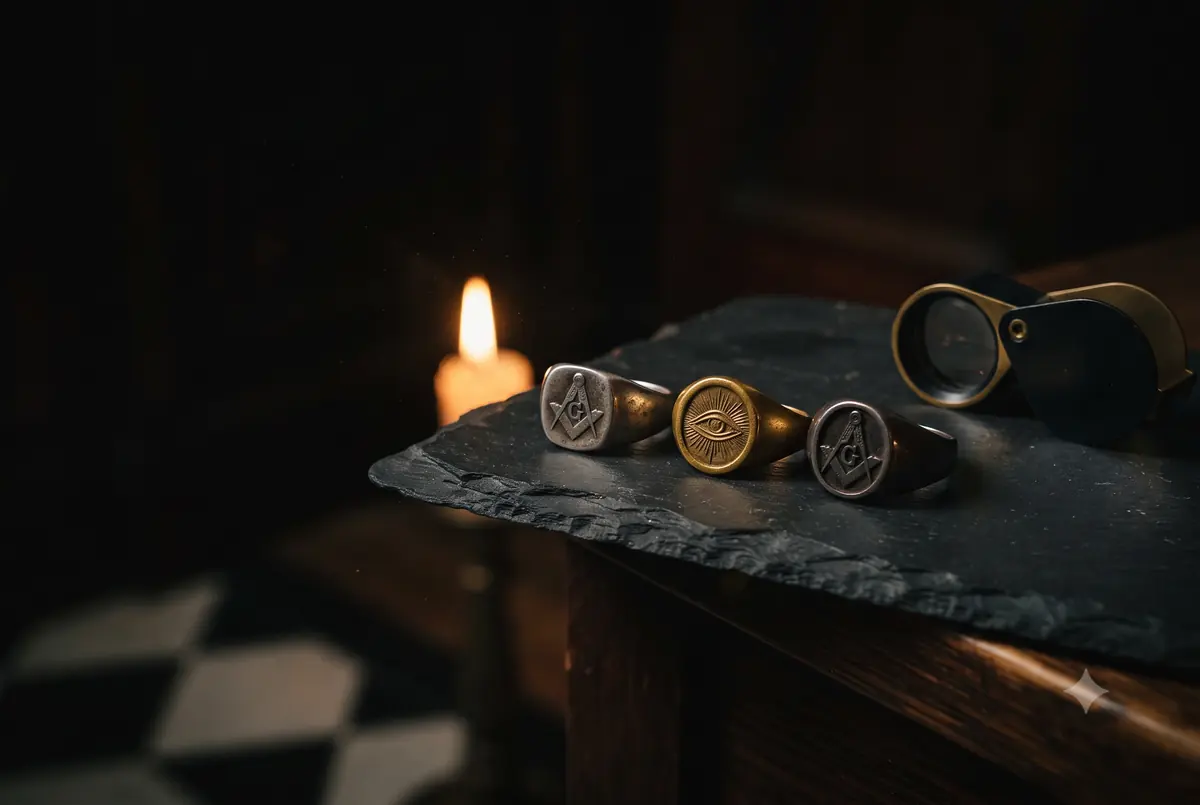
Most Scottish Rite rings on retail sites follow a few families. The names below describe what you will see; they do not make a seller’s claim official.
- The double-headed eagle. The emblem most people picture for the Rite, usually shown with a crown and a sword, sometimes with the number 32 or the letters of a motto. It is the usual 32° design.
- A numbered band or plain signet. A ring with a degree number worked into a band, sometimes in a plain face for quieter wear.
- Triangle or Lodge of Perfection designs. The 14° ring is the best-known of these. Some rings carry symbols associated with the earlier “Perfection” degrees, and listings often label these 14°. The exact design a body recognizes varies.
Whether a ring should show wings raised or lowered, one eagle or a particular crown, is not settled by one rule across the Rite. Treat a seller’s statement about “correct” detail with caution, and check with a member of the Valley.
The 33° is not for sale to everyone
The 33° is an honorary degree conferred by a Supreme Council. It cannot be petitioned for or earned by attendance, and it is not the same thing as a 32° ring in a different metal. A retail listing that calls a ring 33° does not change who may wear it: only a man on whom the Supreme Council has conferred the degree. This guide’s shelf leaves them out on purpose; the rings category lists them in a separate lane marked as an earned emblem, for the men who hold the degree.
Jurisdiction matters
The Rite is organized into Supreme Councils with separate territories. In the United States, the Northern Masonic Jurisdiction and the Southern Jurisdiction each follow their own practice, and Pennsylvania falls in the Northern Masonic Jurisdiction (see Pennsylvania Freemasonry). Degree names, ring customs and what a member receives at each stage are not guaranteed to match across them. Confirm with your Valley Secretary.
Metal, weight and finish
Rings in this category are sold in several constructions, and the words are not interchangeable:
- Solid gold or sterling silver. Check the stated purity (for example 10K or 14K, or .925) and whether a hallmark is shown. Solid gold is a very different purchase from gold-colored metal.
- Gold plated, “Pld” or gold tone. A thin layer over another metal. Plating wears, especially at the edges of a design a wearer touches every day.
- Stainless steel and tungsten carbide. Durable and lower priced. Both are often difficult or impossible to resize in the usual jeweler’s way, so order the right size and ask a jeweler before assuming either way.
- Titanium. Light and hypoallergenic for most people; also often hard to resize.
A listing for a heavy ring often gives a weight in grams. Compare it with the metal named, and read it as the seller’s statement. This catalog holds no live specifications, so confirm the final details on the current listing.
Sizing
Size from a ring the wearer already has on the same finger, or have a jeweler size him. Wide bands and large faces fit tighter than a thin band of the same stated size, so many people go up half a size for a wide ring. Check the listing’s return and exchange terms before ordering, since a ring in a hard metal is often hard to adjust afterwards. The sizing section of the ring guide explains the same points.
Before you buy
- Confirm that he is a Scottish Rite member and has received the degree shown.
- Ask which degree and design he wears, and which hand, rather than guessing.
- Do not choose a 33° ring unless the wearer has had that degree conferred. The rings category lists them in a lane marked as an earned emblem, for holders only.
- Read the metal and weight as the seller states them, and check for a return policy.
- Check the size against a ring he already wears.
Nothing here comes from ritual. Everything on this page rests on what the Scottish Rite publishes about itself. We are not the seller; each item below links to a retailer. For the rest of the category, browse Masonic rings, and for the Rite itself see York Rite vs. Scottish Rite and how to join the Scottish Rite.
Frequently asked questions
Can any Master Mason wear a Scottish Rite ring?
No. A Scottish Rite ring identifies a member of the Scottish Rite, and a Master Mason who has not joined and received the degree it shows should not wear it. The Master Mason degree is the highest degree in Freemasonry; the Scottish Rite is an additional body a Mason may choose to join, not a promotion above the Craft.
Which Scottish Rite degree is the ring for?
It depends on the jurisdiction and the Valley. Rings commonly carry the double-headed eagle for the 32° or a design tied to the 14°, but which degree a member wears is a matter of local custom. Ask the Valley Secretary rather than relying on a seller's title.
Can I buy a 33° ring?
Not as a purchase to be earned. The 33° is honorary, conferred by a Supreme Council on members it chooses to recognize. It cannot be petitioned for or earned by attendance. This page does not put 33° rings on its shelf for that reason.
Should the eagle's wings point up or down?
Practice differs between members, Valleys and jurisdictions, and we do not claim one position is correct everywhere. A new member can ask his Valley what is customary before choosing.
What can I give someone who is about to join the Scottish Rite?
Wait until he has received the degree. A candidate for the Rite can be given something that carries no degree, such as a book on the Rite's history, and the ring can follow when he asks for it. See the guide to joining the Scottish Rite for the steps.