The Three Degrees of Blue Lodge Masonry
Entered Apprentice, Fellowcraft, Master Mason: what each degree is about, what happens between them, and why the third is the highest degree in Freemasonry.
Craft Masonry has three degrees. Not thirty-three. Three.
Everything else (the Scottish Rite’s 32°, the York Rite’s orders, the Shrine) is appendant, taken afterward, and does not rank above these. The Master Mason degree is the highest degree in Freemasonry. Everything a Mason is, he is because of these three nights.
This page describes what the degrees are about and what surrounds them. It does not describe the ceremonies, because a candidate experiencing them cold is the entire point and no Mason will spoil that for you.
The shape of it
Each degree follows the same broad pattern: a candidate is prepared, admitted, taken through a ceremony that dramatizes a lesson, given a set of symbols and working tools tied to that lesson, and then charged, told plainly what is now expected of him.
The symbolism is drawn wholesale from operative stonemasonry. You are a rough stone being made fit for a building. That metaphor is the spine of all three degrees and it never really lets go.
Between degrees you learn a catechism: a question-and-answer proficiency, delivered from memory, that must be returned before you advance. How much varies enormously by jurisdiction. Some ask for a modest proficiency; Pennsylvania and several others ask for a great deal.
First degree: Entered Apprentice
The theme is beginning. Darkness to light, ignorance to instruction, the raw stone before any tool has touched it.
The Entered Apprentice is taught the value of a plain and honest start: that he arrives with nothing, that he is judged on what he is rather than what he owns, and that he is now under obligations he did not have yesterday.
After this degree you are a Mason. You are not yet a full member (you cannot vote, hold office, or in most jurisdictions visit other Lodges), but the fraternity has begun.
What you get: a plain white apron, which most jurisdictions present to keep and which is, as every Mason is told, more ancient and more honorable than any other badge a man can wear. It is also the apron you will be buried in, in many jurisdictions.
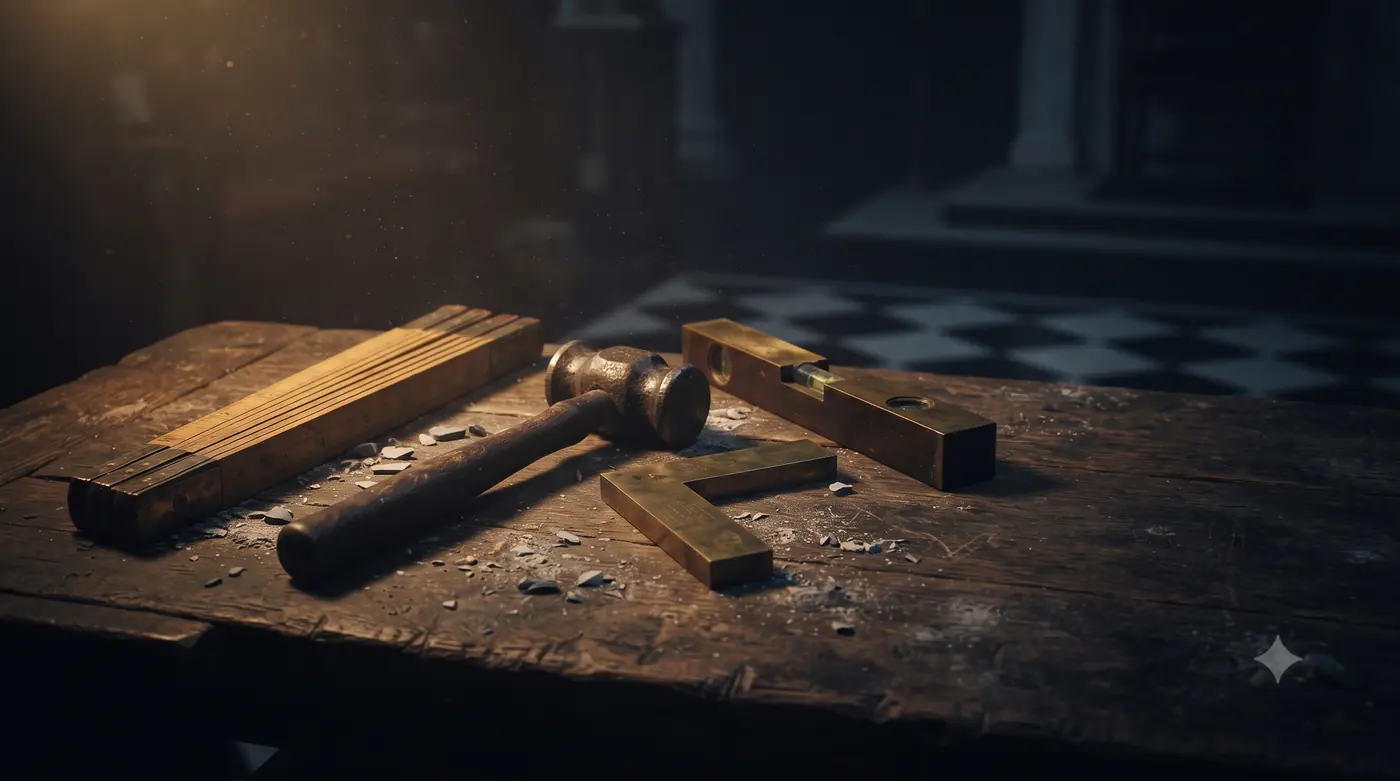
The working tools of the degree are the twenty-four-inch gauge and the common gavel, measuring your time, and chipping away what does not belong. See the working tools explained.
Second degree: Fellowcraft
The theme is education. The Fellowcraft degree is about the middle of a life’s work: the acquisition of knowledge, the disciplines of the mind, and the obligation to keep learning.
It is the least talked-about of the three, and unfairly so: it contains some of the richest material in Craft Masonry, including its treatment of the liberal arts and sciences, and a great deal of the symbolism that men spend decades unpacking.
A Fellowcraft still cannot vote or hold office. He is mid-journey by design.
The working tools are the plumb, the square, and the level: uprightness, morality, and equality.
Third degree: Master Mason
The theme is mortality, integrity under pressure, and what survives a man.
This is the degree Freemasonry is built around. It is the longest, the most dramatic, and the one every Mason remembers the details of decades later. It centers on a legend set at the building of King Solomon’s Temple, and on a man who would not break his word.
The ceremony of being made a Master Mason is called being raised. That word is doing work; you will understand why afterward.
On completion you are a full member: voting rights, the right to hold office, the right to visit other Lodges, and the right to petition the appendant bodies. This is where Freemasonry proper ends and everything else begins.
The working tool is the trowel, spreading the cement of brotherly love.
What comes after
Three things, in roughly this order of frequency:
- The line. Most Lodges will ask you to take an office, and the officer line progresses year by year toward the Master’s chair (what each office does). If you want to actually learn Masonry, take the office.
- The appendant bodies. York Rite, Scottish Rite, Shrine, and others. All optional. None of them make you more of a Mason.
- The work. Learning ritual well enough to confer a degree on someone else is where a large number of Masons find the thing they actually came for.
The one warning
Do not rush the degrees, and do not let anyone rush you.
One-day classes exist in some jurisdictions and serve a real purpose for men whose circumstances make the normal timeline impossible. Taking the degrees over time, studying the required material, and seeing other candidates’ degrees can give each lesson more room to settle.
You only get to receive these once.
Frequently asked questions
What are the three degrees of Blue Lodge Freemasonry?
They are Entered Apprentice, Fellowcraft, and Master Mason, taken in that order. Each uses ceremony and stonemasons' working tools to present a different moral lesson.
Is the 32nd or 33rd degree higher than a Master Mason?
No. The Master Mason degree is the highest degree in Craft Freemasonry. Scottish Rite degrees are additional lessons in an appendant body, not promotions above the third degree.
How long does it take to complete the three degrees?
The schedule ranges from a few months to more than a year. It depends on the Lodge's degree calendar and the proficiency rules of its Grand Lodge.
Can an Entered Apprentice or Fellowcraft visit another Lodge?
Visiting rights for members who have not yet become Master Masons vary by jurisdiction and by the degree on which the Lodge will open. Ask the Lodge Secretary before traveling.